What the Iran war has cost so far, and what the Pentagon is asking for next: $45 billion, $87 billion, $1.5 trillion
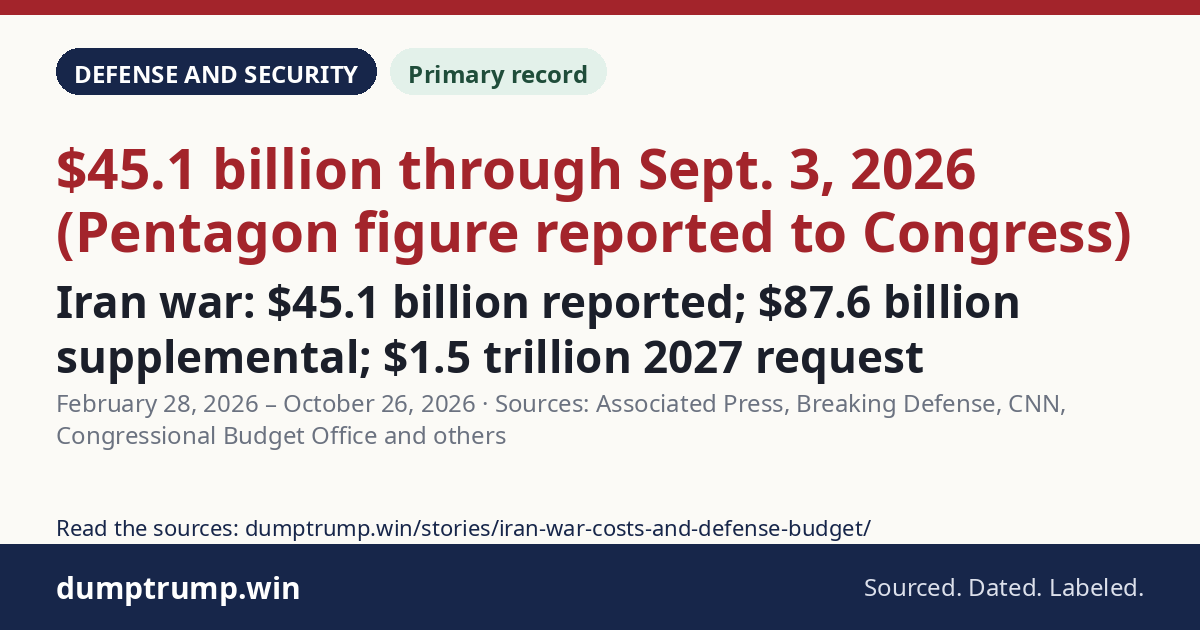
The Pentagon reported $45.1 billion in Iran war costs through early September 2026 (CBO: $38 billion through August 1); an $87.6 billion supplemental is pending and the 2027 request seeks $1.5 trillion for defense.
- People and organizations
- Trump administration, United States Congress, Donald Trump
- Places
- United States, Iran
- Evidence label
- Primary record — A court filing, ruling, agency document, executive order, inspector general report, official dataset or regulator order that we opened directly. More
- Research records
- HCR20261021-15
What happened
The United States and Israel began military operations against Iran on February 28, 2026, according to the Congressional Research Service, and the Congressional Budget Office says the initial intense phase lasted just over a month, with lower-level combat continuing afterward [5][2]. On September 18, 2026, the Pentagon informed Congress that the war had cost $45.1 billion: $43.6 billion as of September 3 plus $1.5 billion for extra fuel, CNN reported, citing two sources familiar with the briefing [1]. That figure excludes the cost of repairing damaged bases and does not break out indirect costs lawmakers had requested [1].
Three days earlier, CBO had published its own estimate: about $38 billion in Defense Department costs through August 1, 2026, with continuing costs of $2 billion to $3 billion a month, more in periods of heavier fighting [2]. CBO put the cost of replacing expended munitions at $21.7 billion, including $13.1 billion for missile defense interceptors, and said it relied on public reports because the Defense Department did not respond to its requests for information [5][2]. The estimate excludes base repairs, costs for killed and wounded service members, and long-term veterans' benefits [3][1].
Why it matters
The war's price is being used to justify two large funding requests. In March 2026, a U.S. official confirmed to Reuters that the Defense Department had asked the White House to approve a request to Congress of more than $200 billion for the Iran war, which met opposition from Democrats and some Republicans [4]. What the White House formally sent Congress on June 24, 2026 was smaller: an $87.6 billion supplemental that includes $67.1 billion for the Defense Department, with $21 billion for munitions [5][2]. CBO calculates that the portion directly related to the conflict, $42.3 billion, is about 10 percent larger than its own cost estimate [2].
Separately, the fiscal 2027 budget requests $1.5 trillion in total budgetary resources for the Department of Defense, which the administration now also calls the Department of War: $1.1 trillion in base discretionary authority plus $350 billion in mandatory funding to be provided through a reconciliation bill [7][8].
The evidence
The "44 percent increase" is the administration's own characterization, but its documents do not agree with each other. The budget director's message and the Department of War chapter describe the $1.5 trillion as "a $441 billion or 44-percent increase from the 2026 enacted level," counting $151.5 billion in mandatory funding from the 2025 tax-and-spending law in the 2026 base, and the budget's Table S-3 shows the War line rising from $1,009.1 billion to $1,450.0 billion, or 43.7 percent [8]. OMB's separate topline fact sheet calls the same request "a $445 billion or 42-percent increase from the 2026 total resource level" [7]. The difference reflects which 2026 figures are used as the base.
None of this is spending yet. The $87.6 billion supplemental has not passed; the House adopted a budget resolution on July 22 with instructions allowing up to $60 billion in mandatory defense funding through reconciliation, beginning in fiscal 2027 [5]. On September 1, 2026 the House voted 370-48 for a continuing resolution funding the government through December 11 at fiscal 2026 levels, and the ranking Democrat on the House defense appropriations subcommittee, Rep. Betty McCollum, said she was "very proud" the bill excluded the president's Iran supplemental [9]. Actual Defense Department military outlays rose $48 billion, or 5 percent, in fiscal 2026 [10].
The official estimates have climbed steadily: near $29 billion in May, about $30 billion in June from OMB Director Russell Vought, and $37.5 billion in Defense Secretary Pete Hegseth's July testimony [6][3].
Response and counterpoints
Hegseth defended the spending in March, saying "It takes money to kill bad guys," and the administration argues the cost is worthwhile to keep Iran from pursuing a nuclear weapon [4][6]. OMB frames the 2027 request as building on "the historic $1 trillion overall Defense topline for 2026" [7]. Rep. Brendan Boyle, the top Democrat on the House Budget Committee, who requested the CBO analysis, said the war "has also cost American taxpayers tens of billions of dollars and counting" [3].
What remains uncertain
The $45.1 billion is a Pentagon figure relayed by congressional sources, not a published Defense Department document, and the Pentagon has not released munitions quantities [1][5]. The "$45 billion in fuel and munitions" shorthand is imprecise: fuel is $1.5 billion of the total, and CBO's munitions figure is $21.7 billion [1][2]. Full costs including base repair, veterans' care and economic effects are unmeasured; outside estimates reported by The Hill run from $38.6 billion to $100 billion or more and are not official figures [6]. The $200 billion was an internal Pentagon request to the White House, never formally submitted to Congress at that size [4][5]. The $1.5 trillion is a request; what Congress enacts for fiscal 2027 is unknown and depends on both appropriations and a reconciliation bill [8][9]. Requests, authorizations and outlays are different things and should not be added.
Money and method
Entity: U.S. Department of Defense. Money types: (1) incremental war costs, February 28 through September 3, 2026, as reported to Congress and estimated by CBO, excluding base repair and casualty-related costs [2]; (2) an $87.6 billion supplemental request, pending [2][5]; (3) a fiscal 2027 request of $1.5 trillion in total resources, pending [8]. Costs are estimates; requests are not enacted; the $48 billion rise in fiscal 2026 defense outlays is the only actual figure here [10].
Sources cited
- [1]
US war with Iran has cost $45.1 billion, Pentagon tells Congress — CNN, 2026-09-18.supports · Paragraphs 1-7: $45.1 billion ($43.6 billion through September 3 plus $1.5 billion extra fuel); excludes base repair and indirect costs; comparison with CBO $38 billion and July $37.5 billion · checked 2026-10-26 · source N-iran-war-costs-and-defense-budget-01
- [2]
Estimating the Cost of Combat Operations Against Iran — Congressional Budget Office, 2026-09-15.supports · 'Summary of CBO's Findings': approximately $38 billion as of August 1, 2026; initial intense phase just over a month; $2 billion to $3 billion per additional month; DoD did not respond to CBO's requests; Administration requested $87.6 billion in June, $67.1 billion for DoD, $42.3 billion directly conflict-related; interceptor inventory opportunity cost; PCE inflation 0.5 percentage points higher in Q1 2027 · checked 2026-10-26 · source N-iran-war-costs-and-defense-budget-02
- [3]
Iran war has cost the US more than $38B, budget office says — Associated Press, 2026-09-15.supports · Paragraphs 1-6: CBO estimate aligns with Hegseth's $37.5 billion Senate testimony; Rep. Brendan Boyle statements · checked 2026-10-26 · source N-iran-war-costs-and-defense-budget-03
- [4]
Huge Trump Iran war funding request faces stiff opposition in Congress — Reuters, 2026-03-19.supports · Paragraphs 1-3: U.S. official confirmed Defense Department asked the White House to approve a more than $200 billion request to Congress; Hegseth 'It takes money to kill bad guys'; opposition from Democrats and some Republicans · checked 2026-10-26 · source N-iran-war-costs-and-defense-budget-04
- [5]
Munitions Expended in Military Operations Against Iran: Issues for Congress (IN12668) — Congressional Research Service, 2026-09-25.supports · Background and 'Congressional Action on FY2026 Supplemental Request' sections: operations began February 28, 2026; CBO munitions figures ($21.7 billion, $13.1 billion interceptors); DOD has not released munitions quantities; OMB June 24, 2026 supplemental including $67.1 billion for military operations against Iran and other DOD activities and $21 billion for munitions; H.Con.Res. 113 adopted by House July 22 ($60 billion reconciliation instruction, FY2027-2036) · checked 2026-10-26 · source N-iran-war-costs-and-defense-budget-05
- [6]
Iran war's rising costs: The hidden price tag of Operation Epic Fury — The Hill, 2026-09-26.supports · Paragraphs on the $87 billion supplemental and its line items ($21 billion munitions, $17.3 billion operational costs, $1.5 billion fuel, $12.1 billion classified); Hurst 'nearing $29 billion' (May); Vought 'about $30 billion' (June); outside estimates (AEI $38.6 billion, CSIS $40 billion, Wharton $45 billion, Bilmes $100 billion) · checked 2026-10-26 · source N-iran-war-costs-and-defense-budget-06
- [7]
Fiscal Year 2027 Discretionary Budget Request: Topline Fact Sheet — Office of Management and Budget, The White House, 2026-04-01.supports · 'Reinvigorate our Nation's Military' paragraph: $1.5 trillion total budgetary resources for 2027, 'a $445 billion or 42-percent increase from the 2026 total resource level'; $1.1 trillion base discretionary; $350 billion mandatory via reconciliation · checked 2026-10-26 · source N-iran-war-costs-and-defense-budget-07
- [8]
Budget of the U.S. Government, Fiscal Year 2027 — Office of Management and Budget, The White House, 2026-04-01.supports · Director's Message pages 1-2 ('a 44-percent increase'); Department of War chapter page 59 ('$441 billion or 44-percent increase from the 2026 enacted level in combination with the $151.5 billion in mandatory funding provided through' P.L. 119-21); Table S-3 page 77 (War row: 1,009.1 to 1,450.0, +43.7 percent) · checked 2026-10-26 · source N-iran-war-costs-and-defense-budget-08
- [9]
House passes funding stopgap, averting government shutdown in October — Breaking Defense, 2026-09-01.supports · Paragraphs 1-4 and Rep. Betty McCollum quote: House passed continuing resolution 370-48 on September 1, 2026, funding government through December 11 at fiscal 2026 levels; CR excludes the Iran war supplemental · checked 2026-10-26 · source N-iran-war-costs-and-defense-budget-09
- [10]
Monthly Budget Review: September 2026 — Congressional Budget Office, 2026-10-08.context · 'Total Outlays' section: Department of Defense military outlays up $48 billion (5 percent) in fiscal 2026 · checked 2026-10-26 · source N-iran-war-costs-and-defense-budget-10
Share
Download card View in gallery Report an error in this story
Related stories
-
Money and Conflicts of Interest
Trump's oil stocks, the Iran war and $7 billion of well-timed bets: what is known and what is not
JEC Democratic staff estimate Trump's oil stocks gained $4.6 million to $15.5 million in 2026; Reuters traced about $7 billion in oil bets placed before his Iran announcements; the CFTC confirmed an open probe on October 22, 2026.
-
Taxes and Public Finance
Trump's $10 billion IRS lawsuit, the audit-immunity deal, and the judge who called it a sham
Trump sued the IRS in January 2026 and settled in May for an apology, a since-rescinded $1.776 billion fund and audit protection; a judge found the suit collusive in July, and the 11th Circuit refused to pause her order on September 29.
-
Foreign Policy
Russian oil sanctions, one year on: repeated waivers, a Hungary carve-out and a $22 billion sale that has not closed
Since sanctioning Rosneft and Lukoil in October 2025, the administration waived them three times during the Iran war, gave Hungary a one-year exemption now up for renewal, and Lukoil's $22 billion foreign portfolio is still unsold.