Coverage losses and premium increases: what CBO projected, what KFF has observed, and where the '12 million' comes from
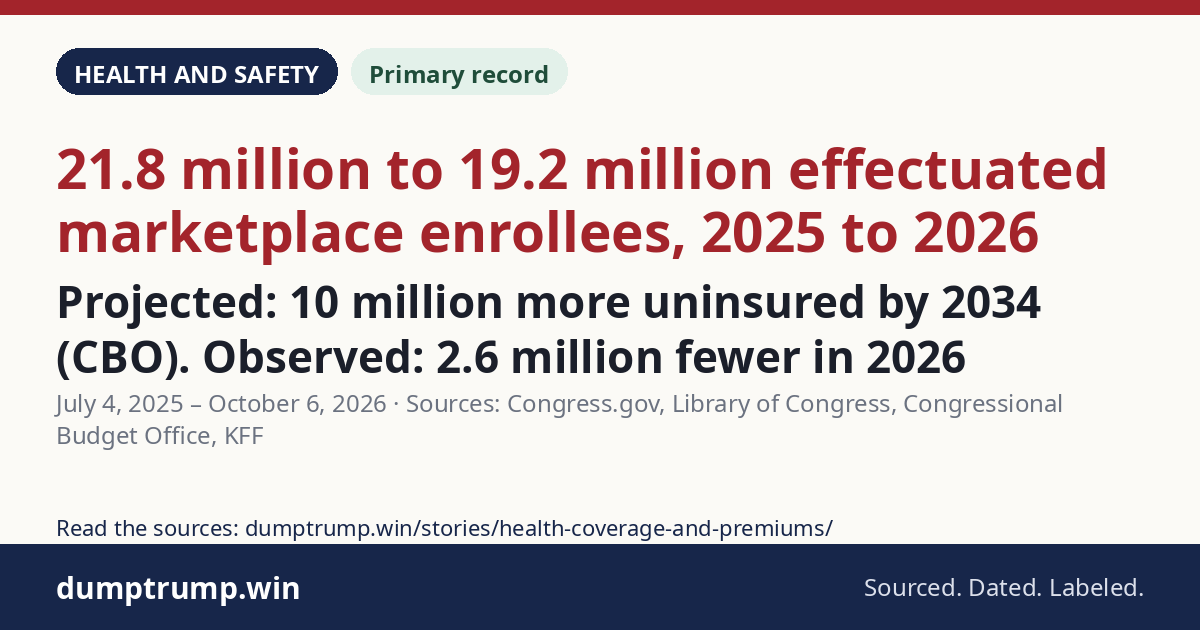
CBO projects 10 million more uninsured by 2034 from the 2025 law, over 14 million with expired enhanced credits; observed 2026 data show marketplace enrollment down 2.6 million and insurer premiums up 26 percent.
- People and organizations
- Trump administration, United States Congress
- Places
- United States
- Evidence label
- Primary record — A court filing, ruling, agency document, executive order, inspector general report, official dataset or regulator order that we opened directly. More
- Research records
- HCR20261021-09
What happened
Two different things are often blended into a single "millions will lose coverage" number: projections of future coverage losses from the 2025 tax-and-spending law, and measured enrollment declines already visible in 2026. The projection is the Congressional Budget Office's. For the law as enacted (Public Law 119-21), CBO estimates the health provisions will increase the number of uninsured people by 10.0 million in 2034, with 7.5 million of that from Medicaid changes and 2.1 million from marketplace changes [1][3]. The largest single driver is the Medicaid work requirement, which CBO expects to add 5.3 million to the uninsured by 2034 [1].
The observed data are KFF's compilation of federal enrollment figures. Effectuated marketplace enrollment, meaning people who actually paid premiums, fell from a record 21.8 million in 2025 to 19.2 million in 2026, the first decline in seven years, and KFF says it could fall as low as 17.5 million during the year [4].
Why it matters
The commonly cited "12 million" has no single CBO source. CBO's June 4, 2025 letter on the House-passed bill put the law's effect at 10.9 million, plus 5.1 million from the already scheduled expiration of the enhanced premium tax credits and a proposed marketplace rule, for 16.0 million combined [2]. After the Senate changed the bill, CBO's estimate for the enacted law came in at 10.0 million [1]. KFF summarizes the current combined picture as "topped 14 million" by 2034 when the law's Medicaid and marketplace changes are added to the expiration of the enhanced credits [4]. A figure near 12 million therefore sits between CBO's law-only estimate and the combined estimate; it reached this project as a secondary attribution to economist Paul Krugman in an October 21, 2026 essay, and no CBO document states it, so it should be presented as an approximation rather than a CBO number [1][2].
The evidence
Premiums rose on two levels. KFF's analysis of 2026 rate filings found insurers raised the amount they charge by 26 percent on average, with benchmark silver premiums up 17 percent in state-run marketplaces and 30 percent in states using Healthcare.gov [5]. Separately, the enhanced tax credits enacted in 2021 and extended in 2022 expired on December 31, 2025, after Republicans in Congress blocked extension efforts, so what subsidized enrollees pay out of pocket rose far more than the sticker price [4]. KFF reports that staying in the same plan would have cost 114 percent more, or over $1,000 a year; because many people switched to cheaper plans, actual payments rose 58 percent on average while deductibles rose 37 percent [4].
The House passed a three-year extension of the enhanced credits (H.R. 1834) on January 8, 2026; the Senate placed it on its calendar on February 10, 2026, and Congress.gov shows no further action [6].
The law also bars many lawfully present immigrants from premium tax credits, requires full repayment of excess advance credits, and adds pre-enrollment verification that could end automatic renewals in 2028, while many administrative verification rules are on hold because of litigation [4]. In September 2026 the administration said it would cancel coverage for more than 760,000 people it says were improperly enrolled and did not respond to a 30-day notice [4].
Response and counterpoints
Republicans who opposed extending the enhanced credits argued they were so generous that they allowed insurers to charge more and encouraged improper or fraudulent enrollment [4]. The administration announced $500 rebate checks for nearly 1 million marketplace enrollees in 30 states, though not for enrollees in state-run marketplaces or for those receiving tax credits [4]. KFF notes that insurer premium increases also reflect hospital costs, GLP-1 drug spending and tariffs, factors that affect employer coverage as well [5].
What remains uncertain
CBO's coverage estimates are for 2034 and are labeled by CBO as "subject to considerable uncertainty" [1]. Enrollment declines in 2026 cannot yet be attributed to the law's provisions specifically, because the enhanced credit expiration, the administration's verification rules and insurer exits occurred in the same period [4]. The 19.2 million figure is for people who paid premiums early in the year; the 17.5 million is a KFF expectation, not a measurement [4]. KFF's 26 percent is the average insurer charge, not what most enrollees pay [5]. How many of the 760,000 cancellations were legitimately enrolled people is unknown; KFF says the process "likely" caught some [4].
Money and method
Entity: ACA marketplaces and Medicaid (federal programs). Measures: CBO's projected change in the uninsured in 2034 relative to its January 2025 baseline (estimates), and KFF's compilation of effectuated marketplace enrollment and premium data for 2025 and 2026 (observed) [1][4]. Status: projections are unchanged since August 2025; enrollment figures are early-2026 snapshots and may be revised [4]. The 26 percent premium figure is KFF's average of insurer rate filings for 2026, published in October 2025 [5].
Sources cited
Share
Download card View in gallery Report an error in this story
Related stories
-
Money and Conflicts of Interest
Trump's oil stocks, the Iran war and $7 billion of well-timed bets: what is known and what is not
JEC Democratic staff estimate Trump's oil stocks gained $4.6 million to $15.5 million in 2026; Reuters traced about $7 billion in oil bets placed before his Iran announcements; the CFTC confirmed an open probe on October 22, 2026.
-
Defense and Security
What the Iran war has cost so far, and what the Pentagon is asking for next: $45 billion, $87 billion, $1.5 trillion
The Pentagon reported $45.1 billion in Iran war costs through early September 2026 (CBO: $38 billion through August 1); an $87.6 billion supplemental is pending and the 2027 request seeks $1.5 trillion for defense.
-
Taxes and Public Finance
Trump's $10 billion IRS lawsuit, the audit-immunity deal, and the judge who called it a sham
Trump sued the IRS in January 2026 and settled in May for an apology, a since-rescinded $1.776 billion fund and audit protection; a judge found the suit collusive in July, and the 11th Circuit refused to pause her order on September 29.